

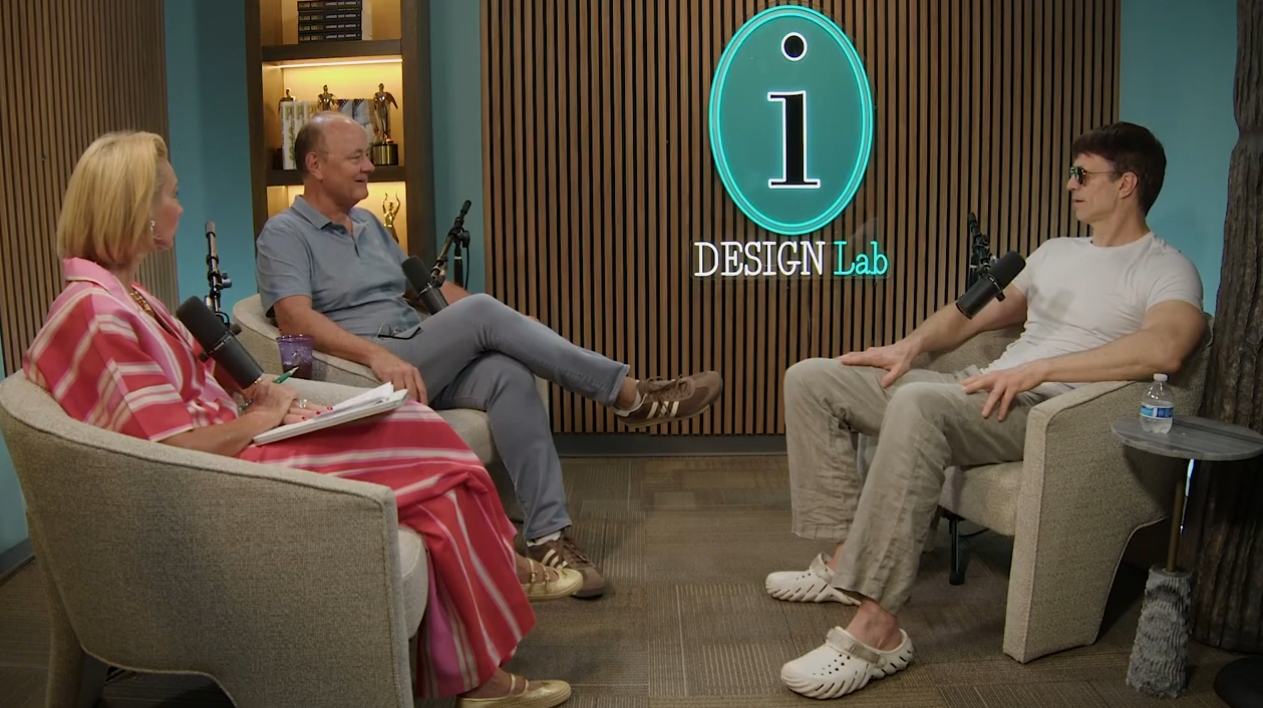
20 Aug He Was Building the Internet Before Google Was “Google.” Now He Says AI Feels Like Déjà Vu.
Eric Simons joins iDesign Lab to argue that the biggest opportunity in your business right now is the one everyone is still calling a fad.
There is a particular kind of confidence that comes from having seen the future once already. Eric Simons has it. Long before “artificial intelligence” became a dinner-party topic and a boardroom mandate, he was in the trenches of an earlier revolution — the one that, in the 1990s, most people dismissed as a novelty. Dial-up. Pop-ups. A place called “the web” that serious people were sure would never replace the Yellow Pages.
He remembers the skepticism precisely because he refused to share it. While everyone else saw a fad, Simons saw the signal underneath the noise: global connection at a scale no one had engineered for, distribution that happened instantly instead of over months, and business models that hadn’t been invented yet because the infrastructure to support them hadn’t existed until that moment. It is, he tells iDesign Lab, the same disbelief curve we are living through right now with AI. History doesn’t repeat — but apparently it does rerun, and Simons has the tape.
For entrepreneurs, interior designers, and creative business owners building something that has to last, the takeaway isn’t nostalgia. It’s a warning dressed as a memory: enabling technology moves quietly, rewriting marketing, operations, and customer expectations long before the wider culture agrees it’s real. By the time the skeptics catch up, the terms of the industry have already changed.
The Origin Story: How a Monetization Problem Became an Empire
Every great transformation has an unglamorous beginning, and Simons’s is refreshingly specific: websites had traffic, and no idea what to do with it. Into that gap, he built one of the first affiliate programs to pay real commissions on real sales — then went further, reverse-engineering how “search” actually worked back when Yahoo, not Google, held the keys to discovery.
What came next was the real education: automation as the advantage. By systematizing domain acquisition, page creation, and publishing, Simons scaled to producing websites at industrial speed — a scrappy, DIY precursor to what we’d now call an AI workflow. It’s worth sitting with that for a second. “AI,” in its earliest and truest sense, wasn’t a chatbot. It was automation. Pattern recognition. Process design, executed relentlessly. And in a market still forming its rules, process beat raw creativity almost every time.
The Casket Story (Yes, Really)
If you want proof that digital transformation has always been equal parts genius and chaos, Simons offers the caskets.
The play: buy expiring domains that already ranked, then figure out how to fulfill the demand those rankings suddenly, inconveniently generated. Simons partnered with a local casket seller, scanned a paper catalog into the internet age, and was immediately buried — pun very much intended — under a flood of phone calls he wasn’t prepared for.
It’s a funny story. It’s also a genuine case study in product-market fit, logistics, and the seduction of a high-margin offer that turns out to have very real, very unglamorous constraints — delivery windows, shipping costs, the gap between “this could work” and “this actually works.” The lesson translates directly to today’s AI gold rush: bolting a powerful tool onto a business without mapping the real-world workflow — the compliance, the privacy, the customer experience that still has to land smoothly on the other end — is how you end up buried in your own success.
What “AI” Actually Means Now
From the caskets, the conversation vaults forward three decades to the AI landscape as it exists today — and what actually separates this moment from the software breakthroughs that came before it. Simons and iDesign Lab dig into agentic AI systems that can operate tools on your behalf — email, calendars, workflows — and the increasingly common practice of using AI to help build the AI, a prototyping method that would have sounded like science fiction five years ago and now sounds like Tuesday.
But the episode doesn’t stop at the applause. It sits with the discomfort, too: deepfakes, voice cloning, scams engineered with unsettling precision, and the real danger of handing enormously capable systems goals that were never scoped carefully enough. Layer in the infrastructure story unfolding largely out of public view — the massive data centers powering it all, the rise of edge models built to run locally for privacy, the long shadow of quantum computing on the horizon — and a clear picture emerges.
AI is not a product. It’s a new layer of computing itself, and it is already rewriting creativity, education, and the shape of human connection — quietly, the way the internet once did, right up until it wasn’t quiet anymore.